
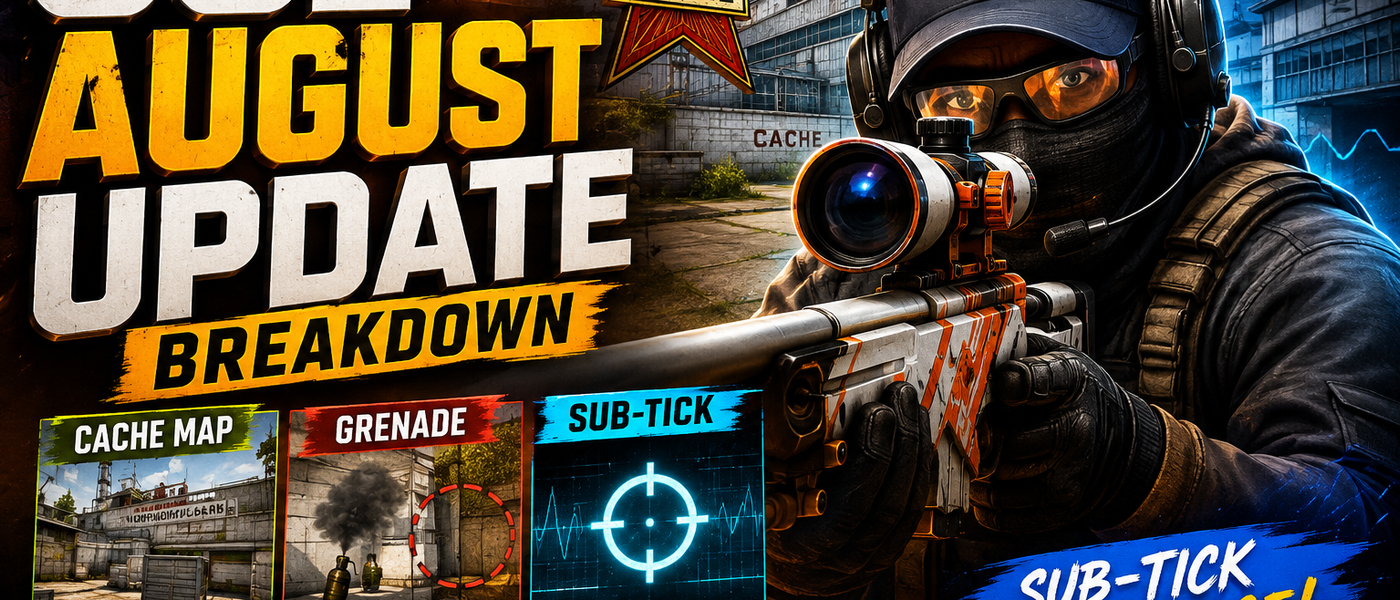
CS2 August Update Breakdown: Cache Map Fixes, Grenade Geometry Clipping, and Sub-Tick AWP Meta Strategy

Valve has officially released a fresh patch for Counter-Strike 2, addressing critical physics bugs, map geometry clipping issues, and technical scripting enhancements. While smaller in scale than major seasonal operational overhauls, this update carries significant implications for competitive play—fixing illegal grenade trajectories, adjusting key sightlines on Cache, and refining player sub-tick interaction settings. In this article, we break down the core patch highlights, map geometry changes, and how to adapt your AWP positioning under current sub-tick netcode conditions.
1. Core Gameplay Fixes: Eliminating Grenade Geometry Passes
One of the most consequential fixes in the patch addresses a longstanding collision bug where grenades could clip through level geometry on certain maps. Throws now bounce strictly against solid collision meshes, eliminating unintended one-way pop smokes that relied on geometry clipping.
2. Cache Map Overhaul & Geometry Tweaks
Following its re-introduction to the workshop and community playlists, Cache has received targeted bug fixes. Valve removed a controversial boost position near Outside A that offered CT snipers an uncheckable pixel angle over main T-side pushes, while sealing wall gaps and fixing shadow rendering inside B-Site sun room.
3. Sub-Tick Netcode & Interp Settings in 2026
- cl_net_buffer_ticks 0 (Default / Low Ping): Recommended for low-ping fiber connections with zero packet loss. Calculates sub-tick inputs with minimal interpolation delay.
- cl_net_buffer_ticks 1 (Jitter Buffer): Ideal for connections experiencing micro-stuttering or occasional packet drops, smoothing player movement without adding noticeable latency.
4. Evolving AWP Meta Strategy: Positioning & Risk Management
In Counter-Strike 2, the AWP remains a high-risk investment. Sub-tick input registration favors active timing peeks rather than holding static pixel angles. With reserve ammo at 5/30, AWPers must manage utility-assisted disengagements and avoid spamming smoke edges.